Experiment builder
A/B, split URL and multi-page experiments with goals, traffic allocation and QA-ready launch controls in one focused flow.
Testvoy brings A/B testing, feature flags, personalization, funnel analysis and shareable reports into one focused workflow.
Teams that own experiment decisions.
Testvoy keeps setup, targeting, reporting and rollout close together so CRO, product and engineering teams can move from idea to decision without stitching tools.
A/B, split URL and multi-page experiments with goals, traffic allocation and QA-ready launch controls in one focused flow.
Marketer-friendly edits plus URL, device, browser, UTM, geo and saved audience rules for precise traffic control.
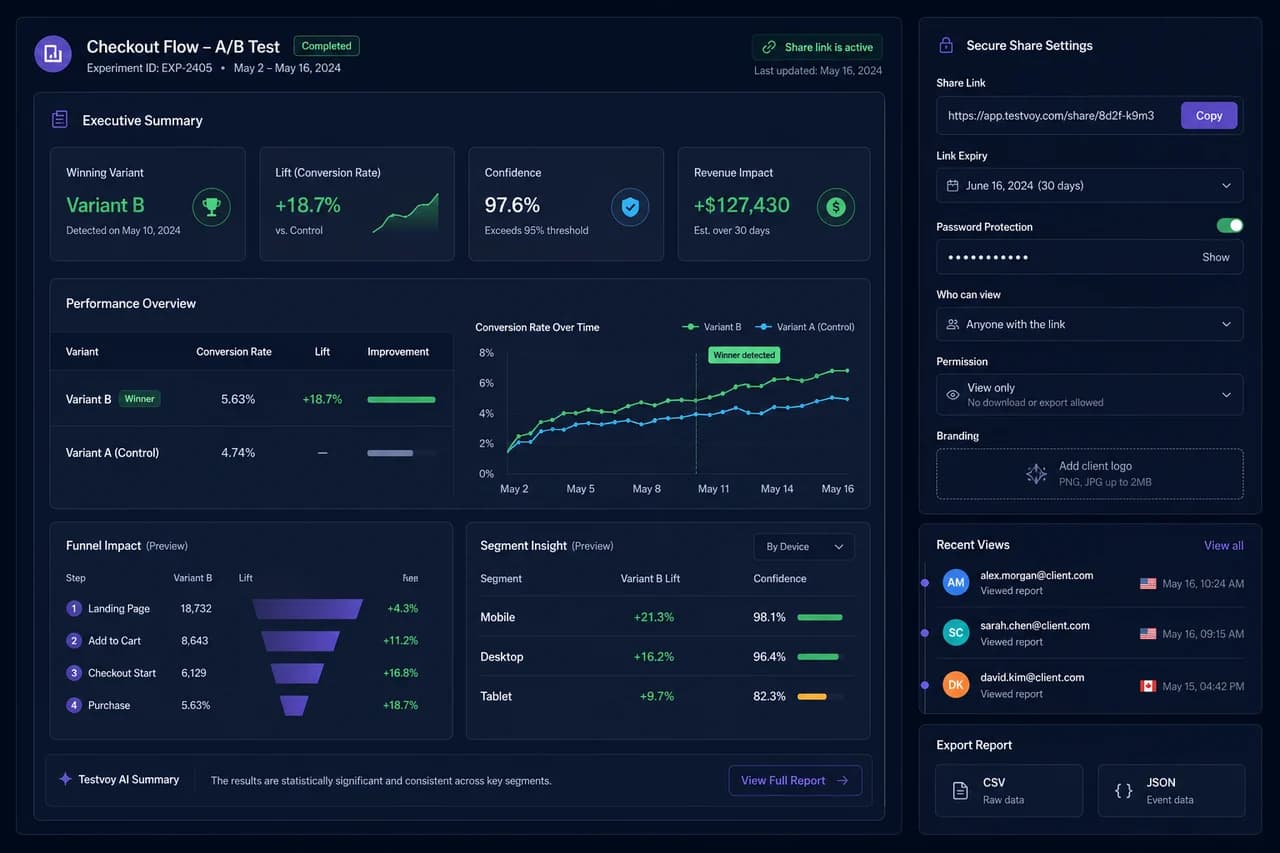
Read variant performance with conversion rate, revenue, funnel steps and segment breakdowns in stakeholder-ready reports.
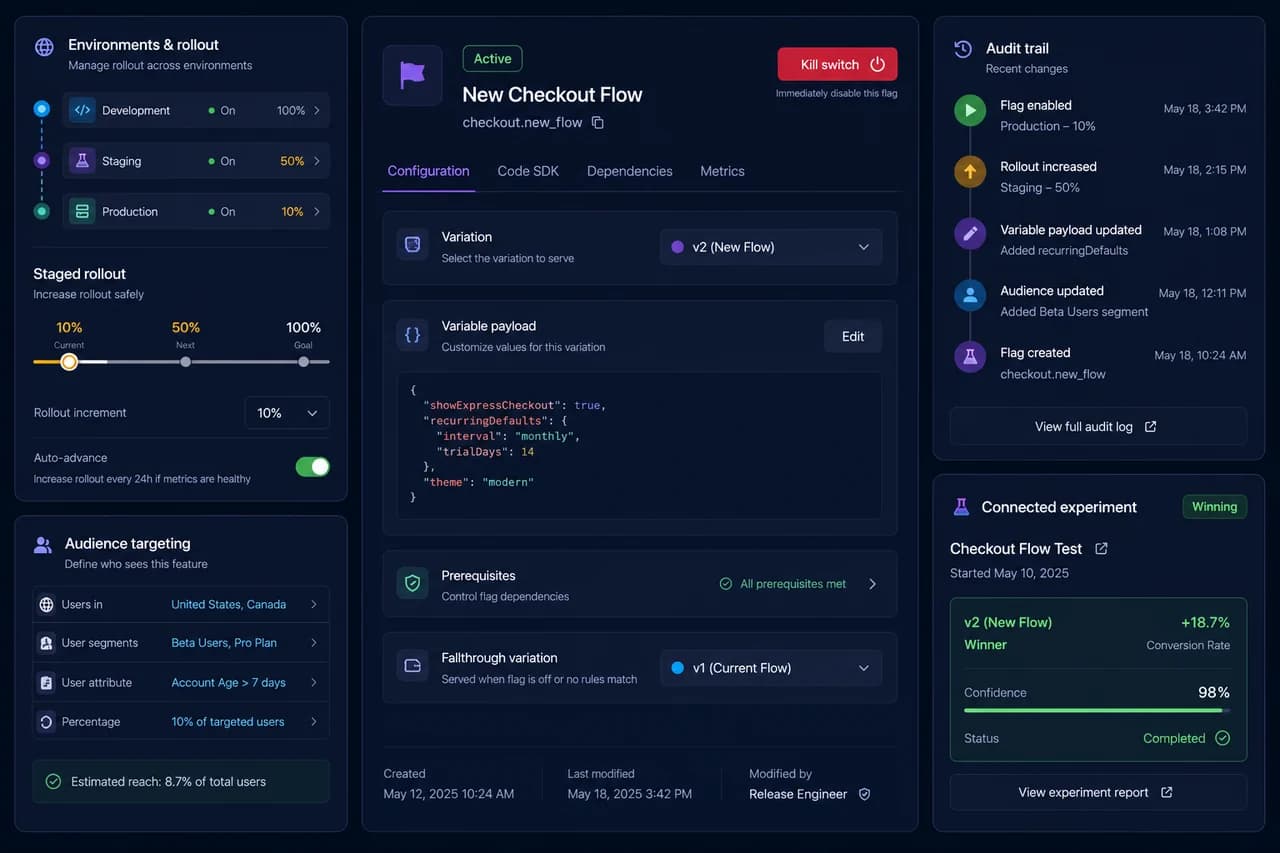
Boolean flags, variables, environments, kill switches and staged rollout give product and engineering one shared surface.
Create polished report links for clients and teams, with expiry and revocation planned for protected sharing workflows.
RBAC, audit views, bot filtering, SRM checks and security-first Enterprise packaging for teams with review requirements.
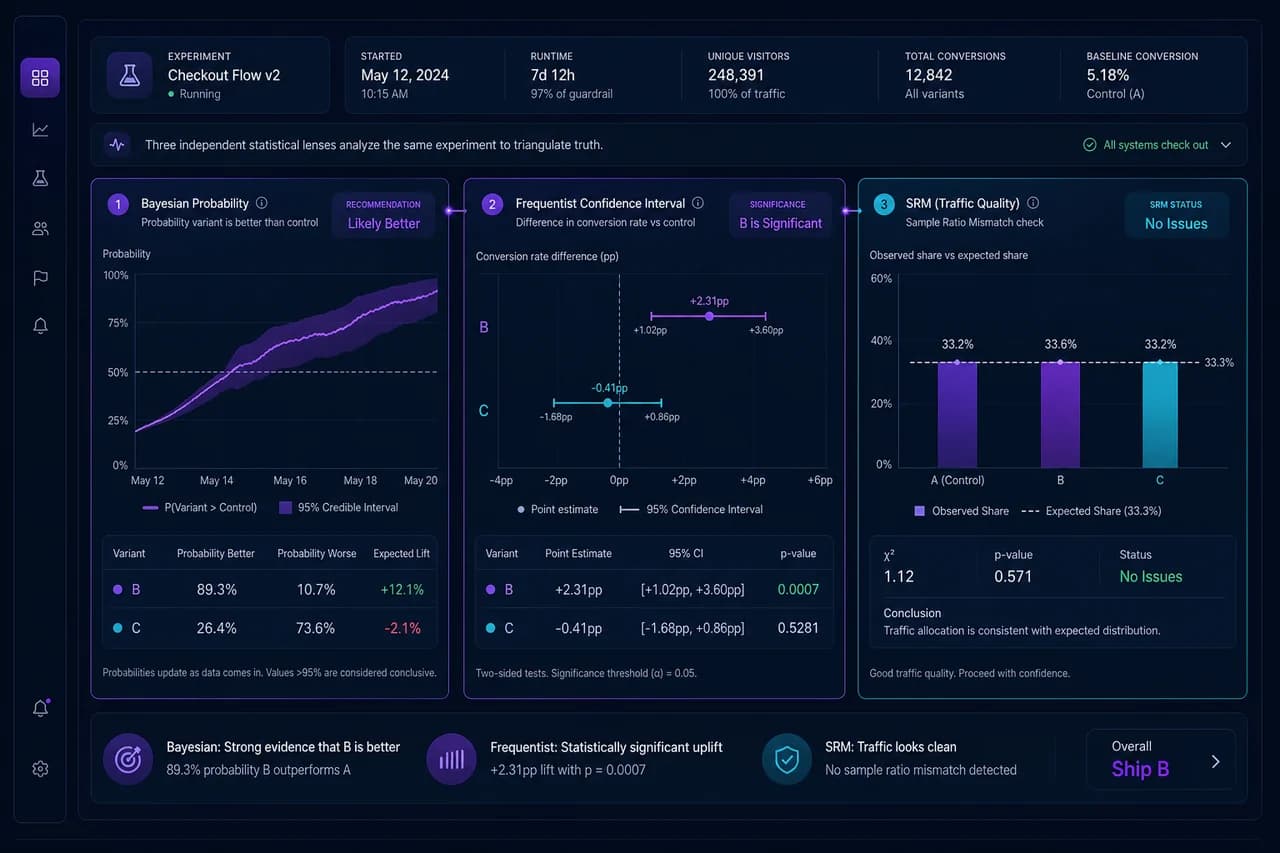
Testvoy does not collapse an experiment into one shiny score. The same experiment data is read through Bayesian decision probability, Frequentist validation and SRM bias detection at the same time. That means the team can see whether the result separates from noise, whether expected loss is acceptable and whether traffic allocation stayed trustworthy before acting on a winner.
The Bayesian view explains how likely Variant B is to win and what loss you accept if the decision is wrong. It turns “should we ship this?” into a clearer business question.
The Frequentist view keeps p-value and confidence interval visible for teams that need a familiar statistical readout. Data and leadership can review the same panel without a separate export.
SRM Detection checks whether traffic split and sample allocation stayed healthy before lift is trusted. If tracking, bots or allocation drift distort the result, the decision is slowed down.
48,217 visitors · 50/50 traffic · purchase_complete
Decision probability and expected loss sit together instead of forcing the team to guess from a threshold.
Teams that expect classical validation get p-value and confidence interval in the same experiment panel.
Before lift is trusted, sample-ratio health and allocation quality are checked.
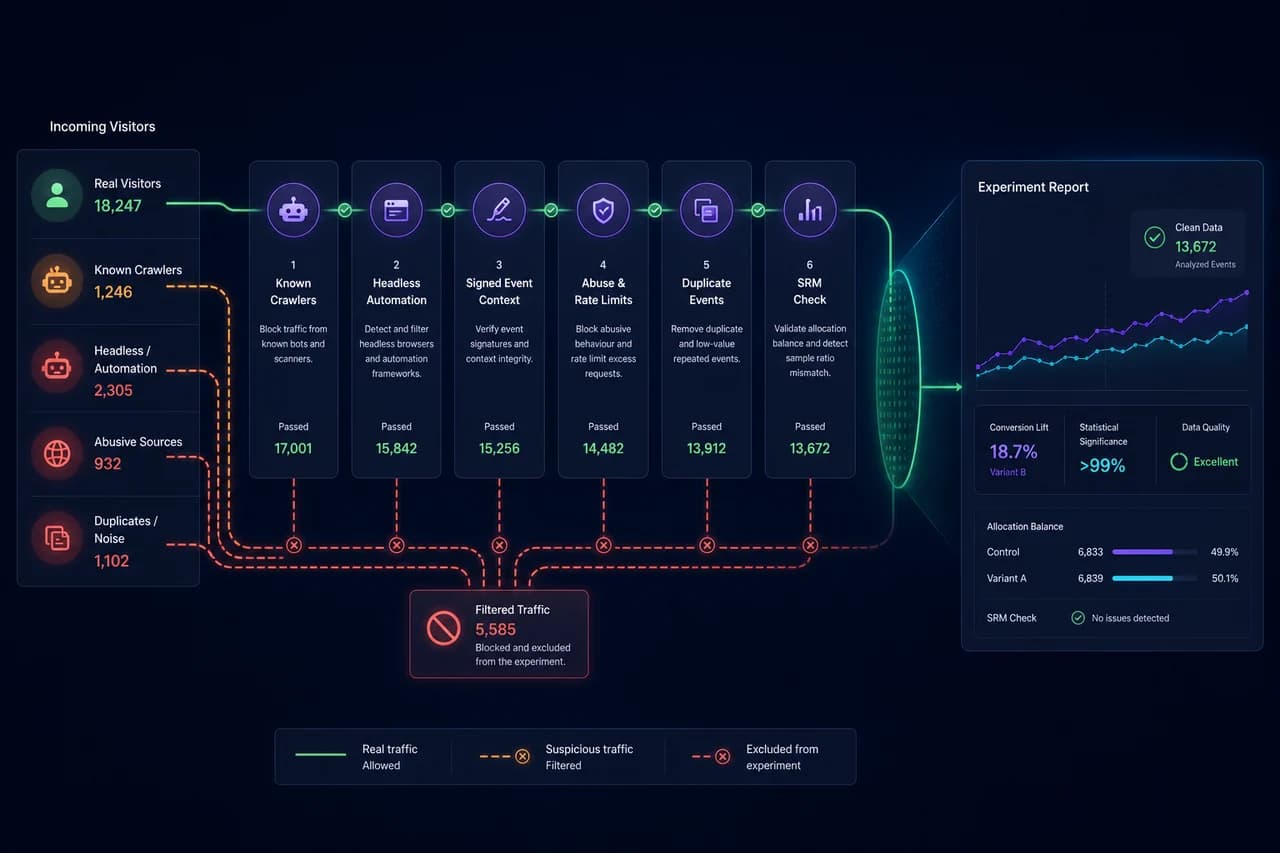
Testvoy checks suspicious traffic, signed event context, abuse patterns and sample-ratio quality before your reports turn into decisions. Your winning variant should be chosen by real user behavior, not by crawlers, duplicated events or polluted traffic.
Known bot user agents, crawlers, headless browsers and automation traces are evaluated separately so they do not distort report accuracy.
SDK events are verified against signed project and experiment context, reducing the chance that fake or misplaced events pollute metrics.
High-volume requests, duplicated event spam and public endpoint abuse are constrained so one source cannot inflate experiment data.
Sample Ratio Mismatch checks catch unexpected traffic allocation; if the split is not trustworthy, the team is warned before deciding.
Suspicious traffic does not simply disappear; reviewable signals and quality warnings support a trustworthy Growth and Enterprise decision workflow.
Privacy-first posture: raw card data, unnecessary personal data or sensitive customer data is not moved into the marketing site. The protection layer exists to protect experiment integrity and data security.
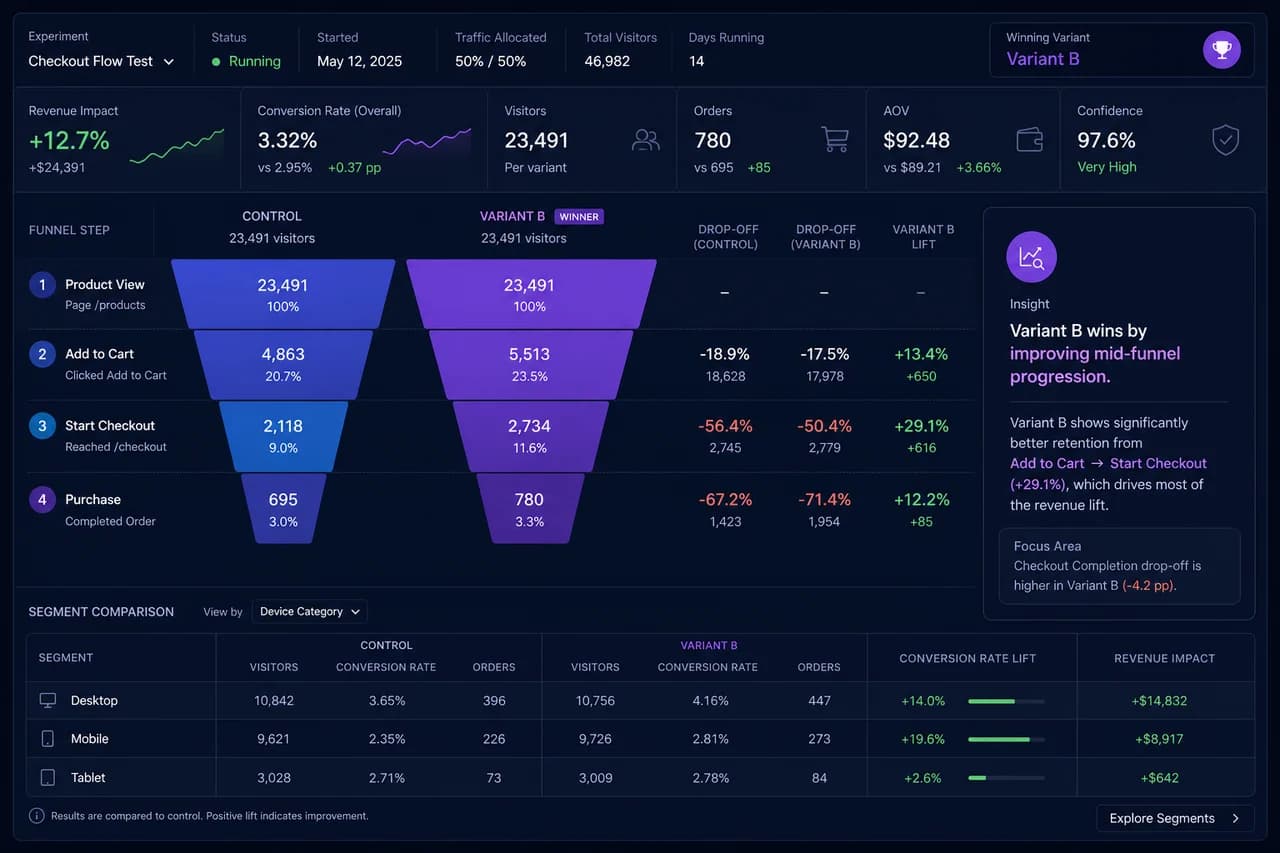
Testvoy shows how users move from the first step to conversion, where they drop off, and which segments change the result. You do not only see the winning variant. You understand why it wins or where the journey breaks.
Read user count, progression rate and drop-off from landing page to completed signup.
A clean funnel view shows where the largest loss happens, helping the team decide where to intervene.
Control and variants are compared at every funnel step, not only by final conversion rate.
Device, country, UTM, campaign source and new versus returning visitors reveal whether the result changes by audience.
Funnel and segment insights can be shared with teams or clients, with CSV/JSON export for meeting-ready decisions.
Change headlines, test CTA copy, add banners, replace images or hide sections without waiting for a developer. Testvoy’s visual editor helps growth and marketing teams launch simple web experiments faster.
Prepare headline, body copy, button text and CTA variations in a marketer-friendly workflow.
Launch campaign messages, promo bars and lightweight banner tests without waiting on a code release.
Test hero images, product visuals or category assets when the visual story needs to change.
Hide a section, show alternate content or compare simple page composition changes.
Review changes in preview mode before launch, with QA checks that reduce the risk of broken experiments.
When no-code edits are not enough, advanced users can move with controlled custom CSS/JS.
New visitors, returning users, mobile traffic, Google Ads campaigns and customer segments do not behave the same. Testvoy helps you target each audience with the variant or campaign that fits them best.
Create audiences like returning visitors, mobile users, cart visitors or high-intent users once, then reuse them across experiments.
Change the message based on page depth, cart visits, previous page views or returning visitor behavior.
Show campaign-aware offers for Google Ads, Meta Ads, email campaigns or influencer traffic.
Serve more relevant variants by mobile, desktop, country, city or browser context.
Differentiate the experience by plan type, lead status, customer tier or account type for SaaS and B2B teams.
After a personalization campaign runs, see which segment responded best to which variant in the same report.
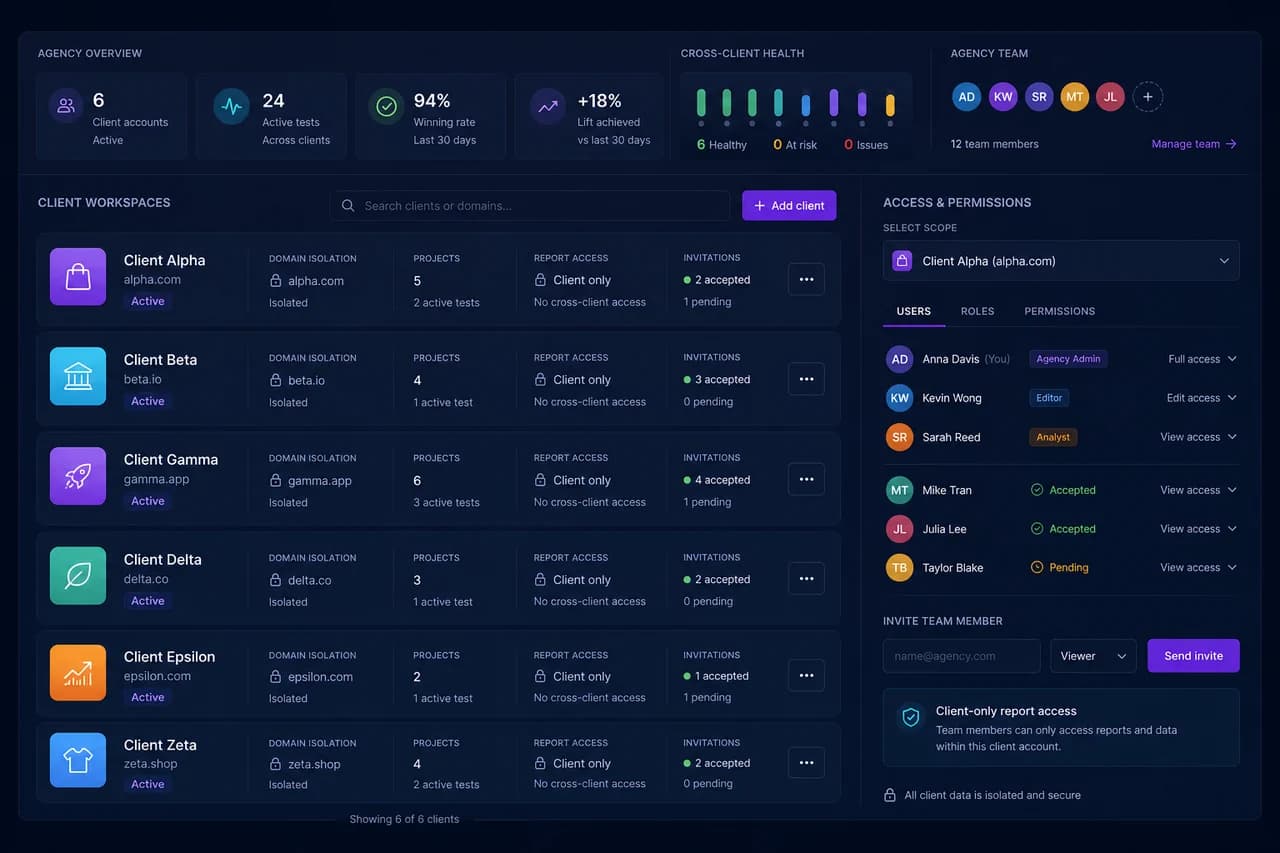
Stop jumping between scattered client files, screenshots and dashboards. Testvoy gives agencies one workspace to manage client projects, experiment performance, shareable reports and team access.
Each client can have its own site, experiment program and reporting scope from one panel.
Use viewer, editor, approver and admin-style roles to scope access for teammates or clients.
Send expiring, revocable report links without giving clients full dashboard access.
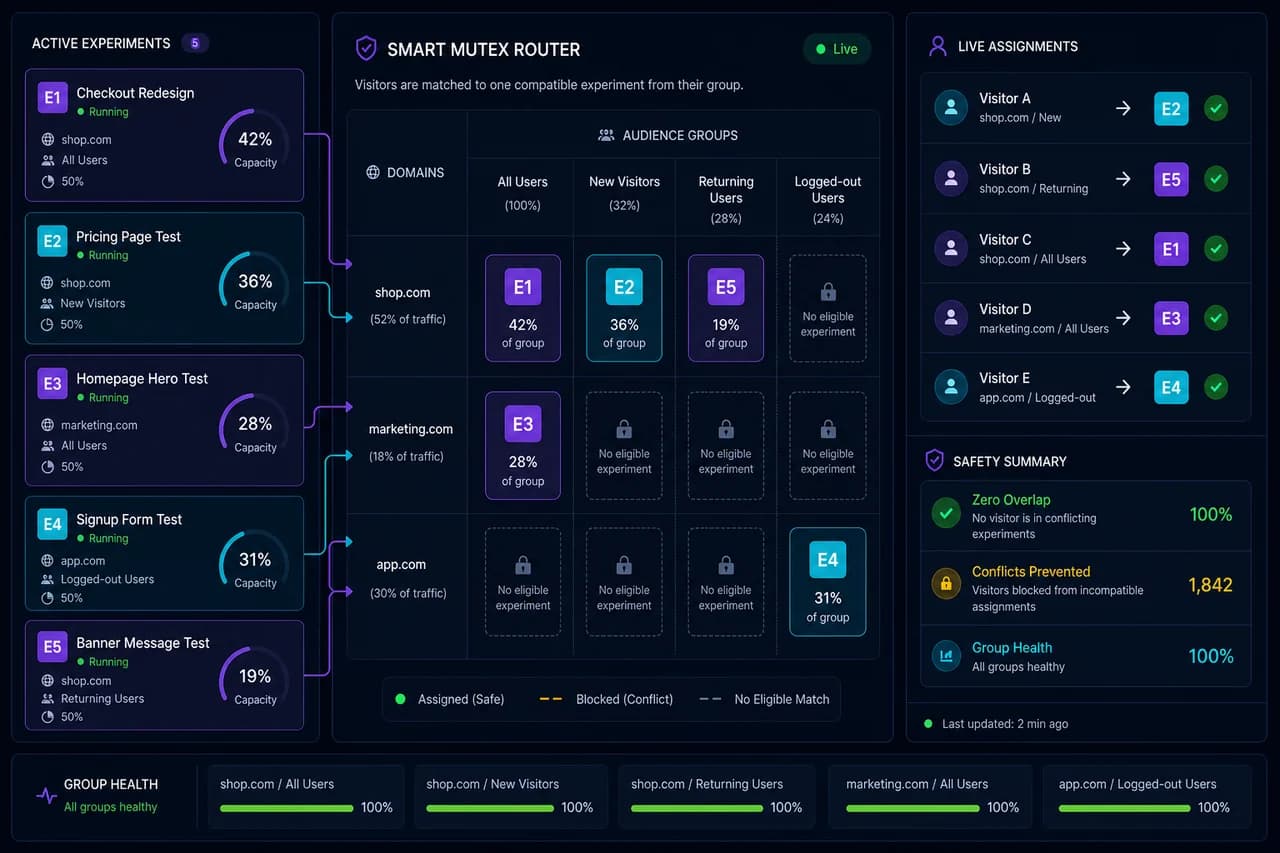
See SDK status, active tests, quota usage and possible conflict signals per client project.
Understand which client is using the most traffic and which project is approaching its limit.
CRO agencies, performance teams and freelancers can keep client operations out of scattered files.
Testvoy’s SDK is designed to load quickly, reduce flicker risk and deliver experiment events safely. Versioned CDN delivery, fallback behavior, signed context and retry logic help keep your measurement pipeline reliable.
Serve the SDK from a controlled path like /sdk/v1/testvoy.min.js so installs stay predictable across client sites.
The SDK focuses on running experiment and event flows with minimal friction on the customer site.
Variant application is designed to reduce flicker risk without promising impossible zero-flicker guarantees.
Fallback behavior helps keep experimentation and measurement less fragile during CDN or network issues.
Events are tied to the right project and experiment context, helping protect report integrity.
Controlled queue/retry behavior helps preserve event delivery during network changes or page exits.
DNT/GPC, opt-out and unnecessary-data-minimization choices are treated as part of SDK behavior.
All the safeguards above come together in one short control line: the right environment, clean data, approved launch and a shareable result.
Confirm the site, environment and goal from one launch preparation view.
QA, traffic quality and guardrail signals stay visible before the decision.
Traffic allocation, audience scope and rollout coverage move forward deliberately.
When the result is ready, send it to the team, leadership or client with one link.
This is not another feature list. It shows how Testvoy turns an experiment result into a defensible decision record for teams, leadership and clients.
Statistics, revenue and funnel signals are reduced into one decision sentence, so the team sees the reason rather than another metric list.
SRM, bot filtering, SDK health and QA warnings stay visible as the issues that could weaken the decision.
Growth, product, data and client-facing teams can explain the same result clearly in their own review meetings.
Seeing the winner is not enough. You need to share why the decision is trustworthy.
The homepage gives you the buying path: validate with Free, choose an MTU band and plan level for Pro/Growth, or talk to sales for Enterprise.
The detailed pricing matrix stays on pricing. This section only answers the decisions that affect the buying path.
Because /pricing is the canonical pricing table. The homepage only helps you choose the path: Free validation, Pro/Growth self-serve, or Enterprise sales.
The public site does not create checkout sessions. Plan CTAs send users to app.testvoy.com/register with sku and cadence parameters.
Enterprise often needs SSO, DPA, SLA, data residency or security review. A sales-assisted review is the better path after pricing intent.
Turkish uses TRY and VAT-included language. English uses USD. Yearly billing explains the effective monthly price with a 20% discount.
No. testvoy.com is the marketing, docs, pricing, support and trust surface. Login, register, dashboard, billing and checkout stay on app.testvoy.com.
Start free on app.testvoy.com, compare traffic bands in pricing, or talk to sales for Enterprise security, SLA and data requirements.